Unknown's avatar

About David Skelhon

David is an accomplished writer, photographer, pilot, sailor and boat builder. He enjoys teaching others these skills and encourages thinking outside "the box".

Clouds and Silver Linings In A World Where Things Fix Themselves

I love quality; that’s why I have always used Nikon photographic gear. It’s the same with other aspects of my life; I once spent the five years driving a diesel Land Cruiser. A quality product, even if it was nearly half my age. I’m also an amateur radio operator, and a fairly miserly one I’ll admit. I can’t afford quality new gear so I dig around flee markets and “ham fests” for quality old.  Most of my equipment is from the era of large, chunky dials, and vacuum tubes. This type of radio is often referred to as a “boat anchor,” as once “dead,”these extraordinarily heavy devices fit the bill exactly. By now you are probably starting to get the picture.

A couple years ago I acquired a Yaesu FT 901 DM, one of the finest radios from the early 80s. It’s called a hybrid radio, because it has both transistors, and in the power amplifier, vacuum tubes. It’s a heavy beast, weighing in at nearly 45 pounds.

This one was almost cosmetically perfect but I bought it for a couple of hundred dollars knowing it needed some electronic TLC. I’m no radio engineer but I know that 90% of problems in electronics usually arise from a mechanical failure, such as a “dry” solder joint or a corroded contact in a switch or relay. Transistors and vacuum tubes have no moving parts and do not wear out in the conventional sense. So I optimistically dug around in the radio with it switched on – something requiring great care and focus as vacuum tubes in these old radios require a whopping 900 volts to operate.

Sure enough, as I prodded one of the many circuit boards, the receiver crackled into life and after 30 minutes of poking around I isolated the problem down to a little metal can containing a crystal filter – a device which helps tune-out unwanted signals. Lifting the corner of the can caused the receiver to scratch and crackle. With a soldering iron in one hand and the vacuum de-soldering tool in the other, I carefully melted and removed the solder from the wires connecting the can to the circuit board. Freed from the board, I then cut the can open to reveal an interconnected web of precisely ground quartz crystals. Further prodding revealed the culprit – a dry solder joint that was easily fixed.

After hastily reassembling, I fired it up. I now had a working receiver but unfortunately my voice couldn’t be heard on the airwaves. I prodded and pulled wires, removed circuit boards and cleaned contacts but to no avail. Frustrated and lacking some essential diagnostic equipment, I could not move forward. Eventually I took the radio to the basement store room and placed it carefully on a shelf several feet from the floor. I covered it with an old sheet and told myself it would be a winter project – one of many requiring my attention. For more than an instant I thought about selling it – no doubt there were lots of capable enthusiasts out there who were knowledgeable enough to be able to fix it. But then it was in such beautiful condition that I hated the thought of parting with it. After all, it’s a piece of history from the days when men were men and radios were huge, tactile machines and indestructible to boot – not the modern wimpy, nano sized devices driven by multifunction buttons and menus.

A few months later, I stepped into the storeroom in search of some unrelated household item, only to find this beautiful piece of history laying on its side middle of the concrete floor. I couldn’t believe it – how could that have happened? My blood pressure was rising as fast as my heart was sinking. Sparks flew in my mind. Had my dear wife accidentally knocked it off the shelf? Hardly likely and hell she would have known if she had, the impact would have been enough to shake the house down to its foundations. I lifted it gingerly, turning it over to inspect the damage. The rear of the casing was bent and the textured green paint irreparably damaged. I was, to say the least, hopping mad. Several hundred dollars had been wiped from its resale value and God knows what damage I might find inside.

Disgusted, I placed it back on the shelf pushing it several inches back from its earlier position. I shook my head – how in the hell could that have happened?

Several months past before I could bare to look at it again. Eventually I took it into the workshop and removed the bent covers to inspect the damage. The impact had popped the vacuum tubes and a mechanical relay from their sockets. I pushed them back into place. Besides the damage to the paint, the chassis was so badly twisted that one of the supporting feet now hovered a good quarter of an inch above the bench.

I plugged it in, expecting nothing. Strangely everything seemed to work on receive at least. Encouraged, I connected it to an antenna, grabbed the microphone, cleared my throat and announced my call sign. To my surprise power needles flicked to very healthy deflections. Wow! I took a deep breath and called, “CQ CQ CQ,” – the amateur radio operator’s request for contact. Instantly a reply came in the form of a male voice with a deep southern drawl, from the other side of the continent, telling me that I had “five-nine” copy and good audio!

I still haven’t figured out how a 45 pound radio ended up on the floor and I doubt that I ever will. Having crashed to the floor myself – literally and figuratively on several occasions over the last few years, I am reminded that not only had other people “written me off”, that I had also taken to writing myself off. But parts of myself had been shaken up in my falls and and like the 901 DM, despite being a little tattered around the edges, I believe I am now in better working order than before.

Change of Tack

It’s 15 years since I gained my commercial pilot’s license and I started my aviation career as a flight instructor a few years later. I had fun teaching others to fly and especially enjoyed helping amateur aircraft builders complete their projects. These projects often concluded with some challenging test flying and problem solving, which I thoroughly enjoyed. After clocking up some 1500 hours of instruction, and flying some exotic aircraft, I turned to the world of bush flying.

For me, bush flying wasn’t the positive experience I expected. The work was seasonal and I had to juggle with other jobs to make it happen. It also quickly became clear that the dangers involved are considerable. When I pulled myself out of the wreck of a Cessna 206 in June 2011, I clearly recall thinking to myself, “I guess it’s all over.” There was barely a pang of sadness; in fact, I felt an upwelling of relief. Relief that neither I or my passengers were hurt and also that I had now acquired the perfect excuse to quit.

I may do some recreational flying from time to time or some aerial photography, but as for flying people and supplies into remote mountain strips, I’m done with it. Aviation at this level is way too underpaid considering the level of risk, and the current gold rush is leading to corner-cutting with potentially lethal consequences. Also, as a colleague once remarked, “aviation is ego driven.” That remark stuck with me and as I reflected on it long and hard I realised he was spot-on. As with other ego driven occupations, aviation tends to bring out the worst in people more frequently that the best.

Financially, a career in aviation – certainly at the seasonal bush flying level – is best suited to young, unattached men. My wife has suffered immeasurably and no doubt she was as relieved as I am that a career change is in the making!

On the other hand I had enjoyed the opportunity to fly in the north and see a little of the Arctic and meet some wonderful, inspiring individuals. This is something difficult to do as a tourist and to see this remote beauty is one of the reasons I chose to come to Canada in the first place.

So what does a newly unemployed bush pilot turn his hand to?

Well, I love boats and sailing. Twenty years ago I set out on a three-month voyage around Britain in a 26 foot sailboat that I had built myself. It was a wonderful, fulfilling experience and as I sailed home for Plymouth in the fall of 1991 it felt as if the journey would continue for the rest of my life.

That journey, however, has taken a rather long pause as other neglected aspects of my life demanded my attention. Although its nature has changed there is still a longing to get back to the ocean and a simpler life and this has been somewhat shared by my wife. After all, I did propose to her on a sailboat so I figure she knew what she was getting in to!

Back in the late eighties and nineties I made my living building and refitting boats. It paid the bills and I also made a name for myself as a freelance sailing writer and photographer. I’m naturally reluctant to go backwards but I considered that if I could find a niche somewhere I would make a go of it. That opportunity came quickly and I’m now on Vancouver Island building and restoring wooden boats.

The world of wooden boats moves at a slower, more humane pace than aviation. Boats, and wooden boats in particular, are driven by aesthetics rather than ego or money.

I’m looking forward to getting back onto an even keel. I’ll keep you posted.

To see my unique aerial photography go to davidskelhon.photoshelter.com

Bush Flying – A Pilots Dream Or Dangerous Nightmare?

This year has been marred by many tragic plane and helicopter crashes in remoter areas of Canada, the most notable being First Air’s 737 in Resolute which killed twelve and injured three, and Arctic Sunwest’s Twin Otter Float-plane that crashed in the centre of Yellowknife killing its crew of two and injuring seven passengers.

These are just two of several fatal accidents that reached national headlines but of course there have been others, some less serious, including my own, which occurred as I was flying workers and supplies into a remote mining strip. Although my passengers and I were badly shaken, there were no serious injuries and we were all able to walk away from the crumpled and partially submerged wreck of the small, fixed-wing plane. It was a humbling and life changing experience.

Later, my employer calmly told me that my accident was actually “the fourteenth wreck at that particular airstrip.” He knew exactly what conflicting emotions I was feeling, but “stuff happens” and like many well seasoned bush pilots (and I consider him one of the very best) he had “been there – done that.” Given the fact that this rather nasty airstrip is currently in the epicentre of a rather frantic new gold rush, it may be only a matter of time before wreck number fifteen occurs and its victims may not be as lucky.

What drives pilots to work in such dangerous environments? In the bush plane world it is definitely not the high salary since this type of flying often pays no more than an average blue-collar trade in Canada (although helicopter pilots usually fare better).

In the very long days of the very short northern summer, pilots can find themselves on duty for 14 hours a day, often in far less than ideal conditions. Much of a pilot’s time is not spent in the air – they are usually loading and unloading aircraft, cleaning and refuelling them and at the end of the day they will spend what can be several hours completing what seems like volumes of mandatory paperwork. Fitting in a healthy meal and getting 8 hours sleep are real challenges.

Yet, there are career bush pilots who thrive in these conditions. They find the challenges, the risk management, the camaraderie and self-sufficiency are exciting and enjoyable. These people are the true professionals and the backbone of the industry, but even so, few of them are immune to lapses in judgement when subjected to strong commercial pressures. They are only human after all.

Young, aspiring airline pilots are often lured into the bush with memories of heroic bush pilot adventures they have read and the promise of those invaluable flying hours they will need to land a job in the more lucrative and safer right seat of a 737. They find themselves on a very steep learning curve requiring close mentorship and many leave to fly more complex aircraft as soon as the opportunity arises. I know that, when I fly as a commercial passenger, I would much rather be sitting in that 737 knowing that the pilot at the controls had served his time in the bush, rather than someone straight out of aviation college.

I enjoy working in the bush. It allows me to experience parts of the world others seldom see. Wilderness flying is pure adventure and I do it because I love it. The fact that, in the course of this work I also meet some wonderful, interesting people, is a bonus.

Unfortunately, there are operational realities that make this one of the most hazardous occupations in North America. To start with, bush strips are often miles from the nearest road. It takes little more than a chain saw and a bulldozer and then you are open for business. There is no safety net of air-traffic controllers or emergency vehicles with crews waiting to roar down the runway and cover crashed air planes with fire suppressing foam. Often, in the mad rush to stake claims and mobilise crews, these small airstrips gradually become surrounded by oceans of fuel drums, supplies and make-shift camps, as well as the usual inquisitive and unwelcome wildlife – all creating serious hazards to arriving and departing aircraft.

Weather is frequently a factor in accidents. In Northern Canada, weather reporting facilities are scarce and, in truth, many experienced pilots quite rightly pay less attention to forecasts and rely more on personal observations and interpretations.

As long as we continue to extract resources from remote areas, bush pilots will be needed. Wilderness flying will never be as safe as scheduled air transportation. Most people willing to go into the bush, whether as pilot or passenger, know that it is an adventure and as such has risks and benefits. Everyone involved should be well aware of those risks and weigh them carefully.

Bush operations could, and should, be made safer. Satellite tracking technology – which effectively narrows a search for a missing aircraft down to a small area – is now affordable even for small charter companies and it seems just common sense that aircraft operating in remote areas should be fitted with these devices. Perhaps it’s time to make them mandatory. Canadian pilots are allowed to work much longer hours than pilots in the US or Europe and fatigue undoubtedly contributes to some accidents. So why do we allow such long hours? Why are dangerous environmental conditions allowed to develop at busy bush airstrips?

Flight safety is a collective responsibility with the pilot at the “sharp end.” Only when all stakeholders – pilots, operators, clients, passengers and regulators stop to consider why we do things the way we do and start tackling some of the issues will these risks diminish.

So remember, the next time you hear the term “pilot error” quoted as the “cause” of an aviation accident, be aware that the pilot was probably just the final link in a very long and over-stretched chain of decisions, over-expectations, necessities and under-regulated work environments.

If you enjoyed this post you might want to read my book, No Time for Fear: Lessons from a Lifetime in Aviation.

Please use the above link or Google as Amazon makes my book difficult to find.

Barrels and parked aircraft line the edge of this busy mountain strip, creating a serious hazard.Copyright David Skelhon, 2011

Old Crow and the Vuntut Gwich’in

This Spring I was fortunate to spend several fascinating days working in the northern Yukon community of Old Crow, about 100 miles south of the Arctic Ocean. Nearly 100 years ago, the Vuntut Gwich’in people lived a nomadic existence heavily dependent on the Porcupine Caribou herd in the Northern Yukon and Alaska. As “civilisation” took hold of the Arctic, the Vuntut Gwich’in were forced into a permanent settlement along the banks of the Porcupine River.

About 300 people live in that community, now known as Old Crow. There are no roads within 100 miles and access is by air, or by boat along the Porcupine River, which meets the Yukon River downstream in Alaska.

Vuntut Gwich’in life has been heavily and and at times forcibly diluted by western culture – they have endured residential schools (where children were forcibly removed from the community to be educated in western ways), alcohol and disease.

Somehow they have managed to retain some of their old ways and hunting and gathering still plays a major part in their lives. They still depend on the land for their existence. Obviously this is a choice as they could default to western culture for their daily needs if they so wished (and no doubt a few do).

When I arrived, the ice on the Porcupine River was weak and fractured after a week or two of warm weather. The break-up is a pivotal point in the Vuntut Gwich’in year and bets were on as to the day the river would become free of ice. These were days of celebration – soon they would be off hunting as the Porcupine Caribou herd heads northwards towards the North Slope as it has done for thousands of years. Even for those with regular jobs, taking time off for the hunt seems accepted as a birth-right.

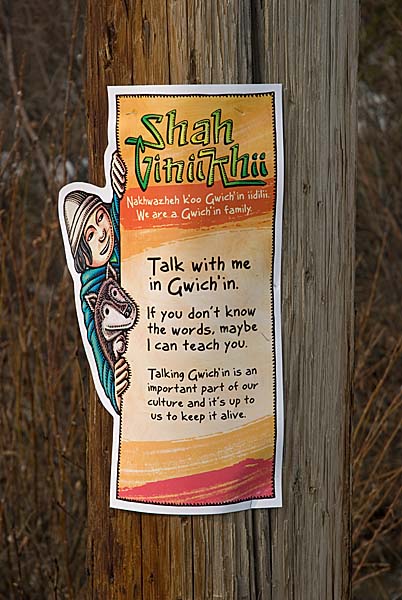
What seemed remarkable, is their integration of modern and ancient. Their lives are not “either/or”. Traditional living is part of school curriculum and there is a drive to keep their language and culture alive.

Transportation is important – the fact that the Vuntut Gwich’in own a 49% share in Air North, the Yukon’s airline, is significant, and so is high speed Internet, snow mobiles and the other staples of modern life. I was also surprised to see a couple of modern community buildings decked with photo voltaic panels – set almost vertical to catch the low arctic sun.

Those I met were bright and friendly and they seem to age extraordinarily well. As a colleague who had lived and worked in the community for 11 years remarked, “They hadn’t seen a vegetable in the community until about 40 years ago.” Their diet was, and still largely is, meat, fish and berries and they seem to thrive on it. I was shocked to find that I had underestimated the ages of several individuals by 20 years.

Interestingly they have embraced aspects of our culture. They love playing the fiddle and square dancing – as I discovered during their “Cariboo Days” celebrations.

I don’t wish to romanticise life in this rare community, as it has its problems like anywhere else. As they have learned from us, I think we have a lot to learn from them. As I departed after four wonderful days in Old Crow I couldn’t help but wish them well.

To see David’s photographs of the Yukon….

Encouraging kids to learn the language and live the culture.