Not Only Bad for Photography, But Bad for Health Too

Are we waking up to the reality that the energy savings from government mandated LED lights are insignificant compared to the health catastrophe they are creating?

As a photographer I love natural and incandescent light over LED light. Certainly LED lighting is efficient but it lacks the full spectrum life on Earth has evolved with, and to me, it just doesn’t look or feel good.

On the domestic front, every winter I swap out our energy efficient LED bulbs for incandescents. Why would I do that? It’s because the quality of light just looks and feels better! Incandescents are supposedly ‘inefficient’ because they emit ‘wasteful’ infrared red light. But incandescent light feels good compared to LED because incandescent is rich in infrared; ultimately that’s why we are drawn to sit in front of stoves and fires on cold winter evenings. If you are a city dweller you are likely denied the right to do that because of the pollution created by burning wood or coal. Even when the winter sun pokes through the clouds, modern life keeps many of us indoors and under LED lighting, and unfortunately, government mandates are making it increasingly harder to find incandescent bulbs in stores.

When the push for LED began some years ago I asked a BC Hydro official why they would get the energy savings they thought they would when the ‘waste’ heat from incandescent bulbs added to the warmth of our homes during the winter months? Moving to LED meant that we would be cranking up the furnace to get the energy from elsewhere – be it gas or hydro. During the summer months we didn’t need our lighting much anyway. He went silent and then said he would need to give it some thought! By the way, I swap back to LEDs in the summer because incandescent bulbs now produce unnecessary heat which then has to be removed by energy hungry air conditioning.

Ten years ago I was stunned by the book “The Fourth Phase of Water” written by Gerald Pollack, head of the Water Lab at the University of Washington State. His work demonstrated, amongst other things, that water can be transformed into a highly energetic and structurally organized state, which is vital for the functioning of living cells. Where does the energy needed to transform water to this higher state come from? It comes from infrared light, and infrared light can penetrate deep within our bodies!

At the other end of the light spectrum we have ultraviolet light which is also essential for human health. We need it to synthesize vitamin D. It isn’t available from indoor lighting and only tanning bed lamps produce the ultraviolet that comes close to that found in sunlight.

We also know that diurnal shifts in the wavelengths of natural light have a profound and complex effect on our hormones. For example, blue light before bed can spoil our sleep. Indoor lighting and electronic devices don’t mimic the variations in natural light – something that may need to change in the future.

The sad reality is that modern life keeps a good proportion of us indoors and under artificial light. I’m convinced that the lack of full spectrum sunlight is a contributing factor in the health crisis our culture is facing. How significant this is compared to the barrage of toxins – both physical and psychological – we are assaulted with daily, we don’t yet know. What I do know is that it feels good to be out in the sun and I will be outside as much as I can!

For an in-depth look at this issue and possible solutions, I recommend the MedCram video in the link below.

A Life Changing Odyssey

2cac9d6d5b3309f676fe655baa5b58543ad6525a-thumbThirty years ago I quit my job in science and engineering. Even in my late 20’s I was tired and disgruntled with the world and my place in it. I wanted to get off the treadmill, and experience the beauty of Planet Earth, or at least my little corner of it.

With my partner at that time, Jill Brown, we looked to the world of sailing for travel and adventure. We sold our home, built a small Polynesian-style catamaran and moved to the ocean. We struggled to make a living in Cornwall, one of the most beautiful counties in the British Isles. I built boats and wrote books and magazine articles. It took a few years but the dream eventually became reality and culminated in an extraordinary voyage around the west coast of Britain in the summer of 1990.

Suilven’s Travels: A Life Changing Celtic Odyssey is my account of this 3 month cruise which was packed with adventure and challenge. Suilven II departed Plymouth in July and headed to the Hebrides, stopping in Scilly, Wales, the Isle of Man and Northern Ireland. The story brings to life the landscape and culture of western Britain and in particular Scotland’s Inner Hebrides. It also shows what is possible on a minimal budget if the desire to succeed is strong enough. I was alone for most of the outbound trip, giving me plenty of time to reflect on the world and my place in it. Jill Brown was with me on the demanding return trip when we struggled against gales and rough seas and came close to losing our small boat on a couple of occasions.

Looking back nearly 25 years it’s obvious there has been dramatic change in our world – especially in technology. But the human spirit and the search for meaning in life is growing stronger as more of us realize it is becoming impossible to thrive in a system which essentially alienates us from our Earth, and our true selves. Suilven’s Travels was written to inspire others to step outside the box and live closer to the Earth. It is available for $3.99 as an eBook on Amazon, Smashwords and many other outlets.

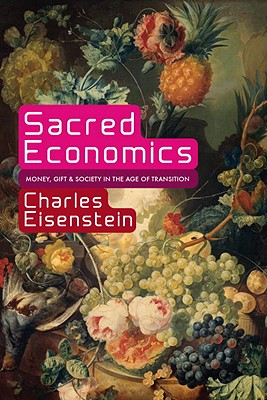
Charles Eisenstein’s Sacred Economics – A Book You Cannot Afford To Ignore

Review by David Skelhon

Every now and then, a really trans-formative book comes along – one that challenges beliefs and opens readers to new ideas. Sacred Economics by Charles Eisenstein is one of those books.

Charles Eisenstein explains that we are experiencing the death throws of an economic system that has brought us some great benefits but at terrible cost. Many of us have been born into this system and know no other. We have been taught a story about money which we have unconsciously internalised without questioning its ethics or consequences.

One result of adopting this story is the need for endless growth originating from a money system that is based on debt and interest. It is a system that breeds artificial scarcity, because to put it simply, there is never enough money in the system to repay the interest on the cumulative debt.

It is a system that can only seem to work if there is economic growth and that ultimately entails the conversion of more and more “gifts” from the Earth – the sacred commonwealth of all humans and indeed all life – into private and corporate ownership for profit. When growth slows, the system collapses, because all the debt can never be repaid – there is never enough money in the system to allow for that, so there will always be losers. It also leads to a “more for you is less for me” culture.

Eisenstein also talks about the innate and insatiable human tendency to hoard money, rather than allow it to flow freely. This is being brought sharply into focus as the divide between rich and poor deepens and the ultimate outcome is exploitation, environmental degradation, war and human misery. He postulates what would happen if we went to a system of zero or negative interest. This actually is not a new concept and has sound roots in history and other cultures, and may form part of the solution.

The author makes it clear that he does not think that money is the root of all evil, rather the problem is in the way we have chosen to use it – the story we have taught ourselves – that is responsible for the misery we are creating. Money plays a vital and necessary role in the complex human interactions of the modern world but he believes we need to change that story.

Certainly, conspiracy theorists my be disappointed by this book because Eisenstein – whilst he acknowledges that they may have some basis and bad things do happen out there – realises that much good energy can be wasted pursuing them. Rather, he encourages the reader to look at things that can be done at the local level to facilitate a return to a kinder, more gift based system where the sacred gifts of the Earth – our birthrights – are respected.

The author is under no illusion that these changes are going to happen overnight, and there possibly will be years of pain before we put our house in order, but the real magic of the book is that it leaves the reader with the impression that these changes must and will happen. Indeed, the process is already underway and ultimately our very survival depends on it.

Sacred Economics is not a cold, factual, academic work – it is non-the-less well researched and referenced. Its real power comes from Eisenstein’s from-the-heart honesty. I found that it resonated with me and more importantly, challenged me at the same time, exposing long held beliefs about money and wealth that I discovered I could well do without. Its twenty-four chapters are not light reading but I consider the concepts so important that I have no doubt I will be dipping back into it again and again.

I will leave the last words to Eisenstein; “A primary goal of this book is to align the logic of the mind with the knowing of the heart: to illuminate not only what is possible but how to get there.”

The book is available in paperback or as an eBook  In keeping with the author’s philosophy, it can also be read on-line for free. http://charleseisenstein.net/